
I spent forty hours in Elden Ring running a build that would make any min-maxer weep.
My stats were spread across four different damage attributes. My talismans had no synergy. My main weapon scaled off intelligence, but I had invested almost nothing in it. I was using a shield that weighed too much for my endurance, and my incantation selection made no logical sense.
And I had an absolute blast.
Somewhere along the way, I realized that chasing the meta had made me forget why I play games in the first place. So I want to throw this out to the room: what's a build you ran that was objectively "bad" – but you loved every second of it?
Why do we obsess over optimal builds anyway?
Before we celebrate the bad ones, it's worth asking why we're so drawn to "the best" in the first place. The answer is partly psychological, partly practical.
The fear of wasting time
When a game takes forty to eighty hours to complete, nobody wants to hit a wall at hour thirty because their build can't handle a boss. Optimisation feels like insurance – a way to guarantee you'll see the credits.
The social pressure of shared knowledge
We live in an age where build guides are everywhere. YouTube thumbnails scream "MOST BROKEN BUILD" and "DELETE BOSSES IN 3 SECONDS." It's hard to ignore that noise, even when you'd rather explore on your own.
The dopamine of big numbers
Let's be honest – seeing a critical hit for 10,000 damage feels great. Optimisation delivers that rush reliably. The problem is, after a while, those big numbers start to feel hollow if the gameplay itself becomes boring.
Why "bad" builds often deliver better experiences
There's something liberating about ignoring the meta. When you stop worrying about being optimal, you open the door to a different kind of fun.
They force you to learn the game differently
A suboptimal build can't brute-force its way through encounters. You have to use every tool at your disposal – positioning, timing, environmental hazards, consumables you'd normally ignore. You actually get better at the game, not just better at following a guide.
They create memorable moments
Nobody remembers the time they one-shot a boss with the meta weapon. They remember the time they barely scraped through with a janky, self-made build that shouldn't have worked. Those victories feel earned, not scripted.
They let you express yourself
Builds are a form of self-expression. Maybe you love greatswords even though daggers are better. Maybe you're obsessed with ice magic even though fire is stronger. Playing your way makes the experience feel personal, not pre-packaged.
Four "bad" builds that were more fun than they had any right to be
I've collected a handful of examples from my own playthroughs – and from conversations with other players. Each one breaks the rules of optimisation, but delivers something far more valuable: genuine fun.
The "every weapon, no focus" build – Skyrim
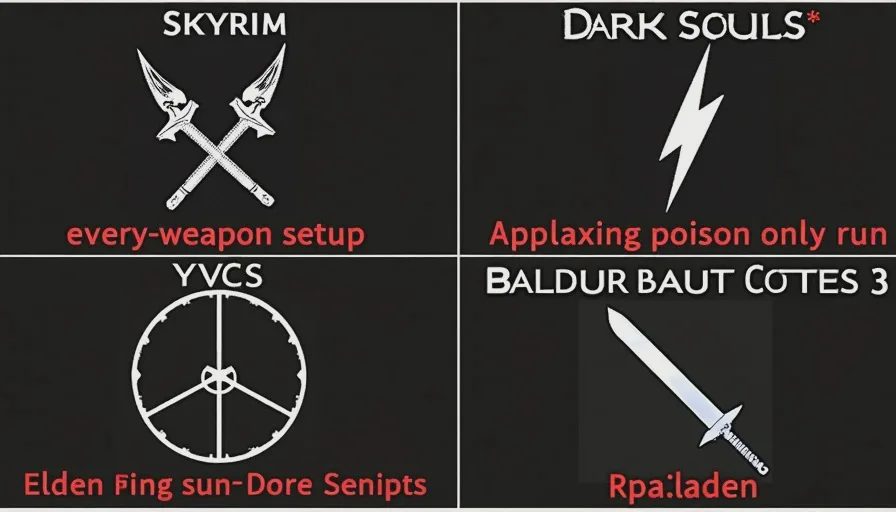
Skyrim's perk system encourages specialisation. One-handed, two-handed, archery, destruction – you're supposed to pick one and commit. Instead, I spread my perks across everything.
The result? I was never the strongest at anything, but I could handle any situation. A dragon swooped down? Bow and arrow. A draugr deathlord got too close? Sword and board. A mage caused trouble? Destruction spells from a distance. Every fight became a puzzle about which tool to use. It was inefficient, chaotic, and the most fun I've ever had in that game.
The "pure support" build – Dark Souls 3
In a game where solo play is the norm, I decided to run a pure support build in co-op. All my points went into faith and attunement. My healing miracles were top-tier, but my damage was laughable.
The result? I couldn't kill anything on my own, but I kept my teammates alive through boss fights they'd been struggling with for hours. The messages I received afterward – "you saved my run," "that was incredible" – were more satisfying than any DPS record. The build was "bad" for solo play, but it created a co-op experience that was genuinely memorable.
The "poison-only" run – Elden Ring
Poison in Elden Ring is widely considered one of the weakest status effects. It deals damage too slowly, and most bosses are resistant to it. So naturally, I built an entire character around nothing but poison.
I equipped the Poison Mist incantation, the Serpentbone Blade, and every poison-related talisman I could find. Boss fights became endurance tests – I'd apply poison, dodge for thirty seconds, reapply, and repeat. Every fight took twice as long as it should have. But there was something hypnotic about watching a health bar slowly tick down while I stayed calm and focused. I beat Malenia with that build. It took eighteen minutes. I still remember every second.
The "RP over logic" build – Baldur's Gate 3
My character was a paladin who worshipped a god of nature. That meant I refused to wear metal armour, use fire spells, or harm animals. None of these choices had mechanical benefits. Many were active disadvantages.
But every decision felt authentic. I role-played my way through the entire game, turning down powerful gear because it didn't fit my character's beliefs. The game rewarded me with unique dialogue options and alternate solutions that I would have missed with a "better" build. I finished the game at a disadvantage in every fight, but I finished it feeling like I had told my own story.
How to spot a "bad" build that's actually worth your time
Not every suboptimal build is worth playing. Some are just frustrating. Here's how to tell the difference.
Does it have a clear identity?
A "bad" build should still feel intentional. If you're just randomly assigning points because you don't know what to do, that's not fun – that's confusion. But if you're committing to a theme, even a weird one, the build has direction.
Does it change how you approach encounters?
A good bad build forces you to think differently. If your suboptimal choices just make fights last longer without any tactical shift, you'll get bored fast. But if they open up new strategies – like relying on items, using the environment, or playing more defensively – the experience stays fresh.
Does it make you smile?
This is the simplest test. When you pull off a combo that shouldn't work, or survive a fight by the thinnest margin, do you grin? If your build gives you moments of absurd joy, it's worth keeping, regardless of what the spreadsheets say.
Over to you – what's your favourite "bad" build?
Now I want to hear from you. Think about the games you've played recently – or even years ago.
Which build did you run that everyone told you was terrible?
Did it surprise you by working better than expected?
Or was it genuinely awful but still gave you the time of your life?


No comments yet — be the first to share a thought.